

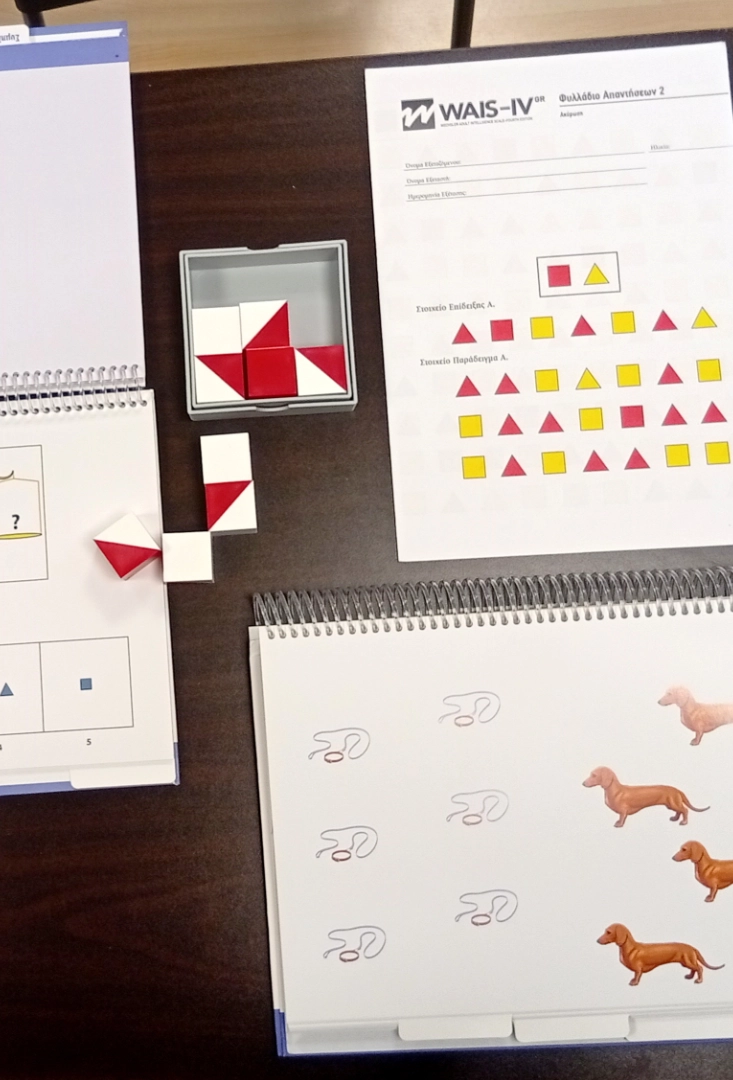


Psychometric (Cognitive) Assessment of adults through the use of the WAIS‑V represents a systematic and scientifically grounded procedure for evaluating cognitive functioning, enabling the mapping of both overall intellectual ability and specific cognitive indices such as verbal comprehension, perceptual–visuospatial organization, working memory, and processing speed.
The significance of such an evaluation does not lie solely in the determination of an intelligence quotient but extends to the differentiated exploration of an individual’s cognitive profile in a qualitative and interpretive manner, allowing the identification of strengths, possible deficits, or asymmetries that may influence functional capacity, academic or professional performance, and everyday adaptive functioning.
Assessment with the WAIS-V is recommended in cases where a documented cognitive evaluation is required for administrative or legal purposes, including procedures related to disability benefits, certification of disability percentage, academic accommodations, or other institutional regulations. Additionally, it may be used in clinical contexts for the investigation of potential intellectual disability, borderline intellectual functioning, cognitive decline, or for differential diagnosis between psychiatric and neurocognitive factors.
The procedure typically involves an individual assessment session that may extend across one or two meetings, during which standardized subtests are administered according to strict instructions and a structured protocol. Subsequently, detailed scoring and clinical interpretation of the results are conducted, taking into account the individual’s educational background, cultural context, and personal history, ensuring that the final report represents not merely a numerical score but a comprehensive psychological evaluation. In certain cases, the administration of additional psychometric instruments may be required in order to support accurate interpretation, such as personality questionnaires or measures used in the investigation of neurodiversity.
The validity and reliability of the WAIS-V are supported by extensive standardization studies and research data demonstrating its discriminative capacity, measurement stability, and comparability with normative population data, characteristics that make it an internationally recognized instrument for clinical, educational, and administrative use.
Particular emphasis is placed on the fact that the administration and interpretation of the instrument are conducted exclusively by a specially trained and certified psychologist who possesses the necessary theoretical training and clinical expertise to ensure the correct implementation of the protocol, the ethical management of data, and the responsible formulation of conclusions.
The final written report delivered to the examinee is comprehensive, clearly articulated, and suitable for official use when required, and it is accompanied by a verbal feedback session during which the results are explained and discussed.
