



Play therapy constitutes a specialized psychotherapeutic approach for children, grounded in the fundamental assumption that play represents the natural language of the child’s psyche and, consequently, the privileged medium through which the child expresses emotions, conflicts, fantasies, and unconscious representations that are not yet capable of being articulated verbally. Within this perspective, play is not understood merely as a recreational activity but as a symbolic mode of communication through which internal experiences acquire form and meaning within the therapeutic relationship.
At the theoretical core of this approach lies psychoanalytic thought, as developed by clinicians and theorists who recognized the therapeutic potential of play, among whom Donald Winnicott occupies a particularly prominent position. Through his conceptualization of the “transitional space” and the “potential space of experience,” Winnicott described an intermediate area between internal reality and the external world in which the child is able to create, experiment, and process experiences in a safe and symbolic manner, thereby facilitating psychological integration and emotional development.
Play therapy should not be confused with unstructured free play or with a simple activity aimed at emotional release; rather, it constitutes a structured therapeutic process that takes place within a stable framework characterized by clear boundaries, consistent frequency of sessions, and professional neutrality. Within this framework, the therapist functions as an emotionally available and reflective companion who is capable of recognizing recurring patterns within the child’s play, tolerating the intensity of the emotions that emerge, and metabolizing the feelings that the child projects into the therapeutic relationship.
Through the symbolic scenarios that unfold in the playroom, the child may represent experiences of loss, fear, anger, jealousy, traumatic events, or intrapsychic conflicts, gradually acquiring the capacity to organize internal experience more coherently, to develop symbolic thinking, and to strengthen emotional regulation. In this process, experiences that are initially enacted in a fragmented or chaotic manner may progressively transform into meaningful representations that can be mentally processed and integrated.
This therapeutic modality is particularly recommended in situations where children present with anxiety, phobias, separation difficulties, aggressive behavior, challenges in adapting to the school environment, psychosomatic symptoms, traumatic experiences, relational difficulties with peers, or signs of internalized sadness that may not be expressed directly. Equally relevant are cases in which children struggle to verbally communicate what concerns them but repeatedly express their internal world through symbolic play scenarios that reveal underlying emotional themes.
It is essential to emphasize that play therapy does not primarily aim at the superficial or immediate modification of behavior; rather, its objective lies in the deeper reorganization of internal representations, relational patterns, and the child’s sense of self. Within a stable and reliable therapeutic relationship, the child may encounter what psychoanalytic theory describes as a corrective emotional experience, allowing new relational patterns to emerge that differ from those that may already have become established within the child’s psychological organization.
At the same time, collaboration with parents constitutes an integral component of the therapeutic process, as regular feedback meetings facilitate the understanding of the child’s needs while also helping parents process emotions such as guilt, anxiety, or uncertainty. Through this collaborative dialogue, parents receive guidance on how to support the child effectively in everyday situations, thereby reinforcing the therapeutic work that occurs within the playroom.
The duration of play therapy varies according to the nature and depth of the child’s difficulties, the developmental stage of the child, and the stability of the surrounding environment. Importantly, therapeutic progress is often reflected not only in the reduction of symptoms but also in an increase in creativity, greater flexibility within play, and improved relationships with significant others such as parents, peers, and teachers.
For parents who wonder “what exactly happens inside the playroom,” it is important to understand that the child’s play is not random but meaningful. The repetition of particular scenarios does not signify stagnation but rather an active process of psychological working-through, within which the therapist operates with clinical precision, theoretical knowledge, and professional responsibility.
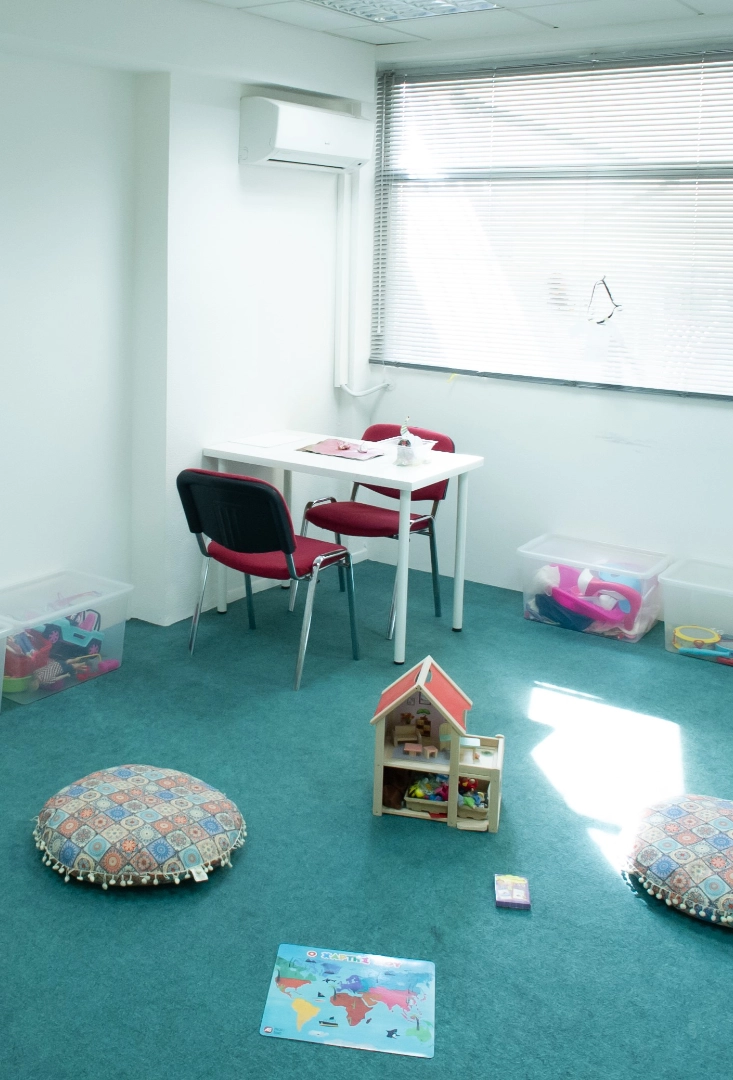
At the Pronoisi Center, specially designed play therapy rooms have been developed in order to ensure the appropriate therapeutic framework, the stability of the setting, and the symbolic functionality of the space, allowing the child to move within an environment that is not merely pleasant but clinically structured and theoretically grounded. The equipment includes carefully selected and scientifically appropriate materials, such as family and animal figures, objects that facilitate the representation of everyday and imaginative scenarios, and materials for creative and symbolic expression.
These materials are not placed randomly but according to the principle that each object may function as a carrier of projection, representation, and processing of internal experiences and conflicts. The organization of the space, the stability of its arrangement, the clear structuring of materials, and the presence of consistent rules of use constitute essential elements of the therapeutic setting, as psychological safety emerges not only from the relationship with the therapist but also from the consistency of the environment itself, which is capable of containing and holding the child’s emotional experience.
